
Borobudur certainly heard the name familiar to our ears, because borobudur including one wonders of the world, by unesco designated as world heritage site that needs to be maintained and preserved because the building has high architectural and historical value. Located in Magelang District, central Java province, or about 40 (25 miles) kilometers to the northwest of the city of Yogyakarta, can be reached by land travel about an hour from the airport.
History:
was built around 800 BC or 9th century by King Samaratungga (one of the kings of Old Mataram Kingdom) which includes the descendants of the Dinasty Syailendra. Based on Kayumwungan inscription mentioned that borobudur completed in 825 AD and is considered as the largest Buddhist temple in the world.
This temple was originally covered with earth and bushes, in the year 1814 Sir Thomas Stamford Raffles (British colonial leaders in Indonesia at the time) ordered the HC Cornelius, a Dutch engineer to conduct excavations around the temple area. New in 1973, the Indonesian government assisted by Unesco held a restoration of Borobudur and completed in 1984.
This temple was originally covered with earth and bushes, in the year 1814 Sir Thomas Stamford Raffles (British colonial leaders in Indonesia at the time) ordered the HC Cornelius, a Dutch engineer to conduct excavations around the temple area. New in 1973, the Indonesian government assisted by Unesco held a restoration of Borobudur and completed in 1984.
Structure of the temple :
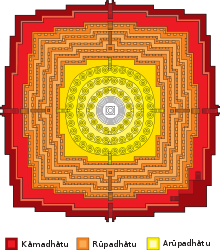
Borobudur berundak punden shape, has 10 levels, which consists of six levels of a square, three-level circular and a circular main stupa as a peak. Also scattered in all levels of domes-level numbering 72 men.
Describing the philosophy of Buddha Bodhisattva of the ten stages to go through to achieve perfection became the Buddha in nirvana. This perfection symbolized by the main stupa at the top level. Borobudur structure when viewed from above form a mandala structure depicting Buddhist cosmology and the human thinking.
The foot of Borobudur represents Kamadhatu, the man who still controlled by kama, or “low desire”. This section is mostly covered by a pile of stones This illustrates the Buddhist philosophy that all life originated from a rocks then sand, then into plants, then into the insect, then a wild animal and pets, and finally became a man.
This process is known as reincarnation. The last process is the soul and finally went into nirvana. Each stage of enlightenment in this life process based on Buddhist philosophy is illustrated in reliefs and statues in the temple of Borobudur. At the close of this additional structure there are 120 panels Kammawibhangga story. Four floors with wall above berelief by experts called Rupadhatu. The floor is rectangular.
Rupadhatu are human beings who are able to free himself from passion, but is still bound by the appearance and shape. This level represents the nature of that is, between nature and the natural bottom up. In part this Rupadhatu Buddha statues found on the wall niches above ballustrade or hallway.
From the fifth to the seventh floor walls are not berelief. This level is called Arupadhatu (which means no tangible form or not). Circular floor plan. This level represents the nature of, where people are free from all desires and the bond forms and shapes, but have not reached nirvana.
Buddha statues are placed in the stupa covered with holes as in a cage. Represent the highest level being represented by the absence of a stupa, the largest and highest-called Arupa symbolizes nirvana, where Buddha is residing. Stupa described plain without the holes.
Relief.

At every level carved reliefs on the walls of the temple, Borobudur has a different reliefs 2670. These reliefs read clockwise or called mapradaksina in Old Javanese language derived from Sanskrit meaning is daksina east.
These reliefs variety of story content, among other reliefs jātaka.Keseluruhan story reliefs in Borobudur temple reflect the Buddha’s teachings. Reading the stories are always the starting relief, and ends on the east side of the gate at every level, start on the left and right ends of the gate. So obviously that is east of the ascent of the real (main) and to the top of the temple, indicating that the main gate of the Borobudur temple facing the east like most other Buddhist temples.


No comments:
New comments are not allowed.